Credit Rebound
PROVE IT: What to Do When a Debt Collector Calls
Old Debt, Important Dates, Validation, and the Two Clocks You Should Understand
By Avery Brooks
November 27, 2026 at 3:30 AM
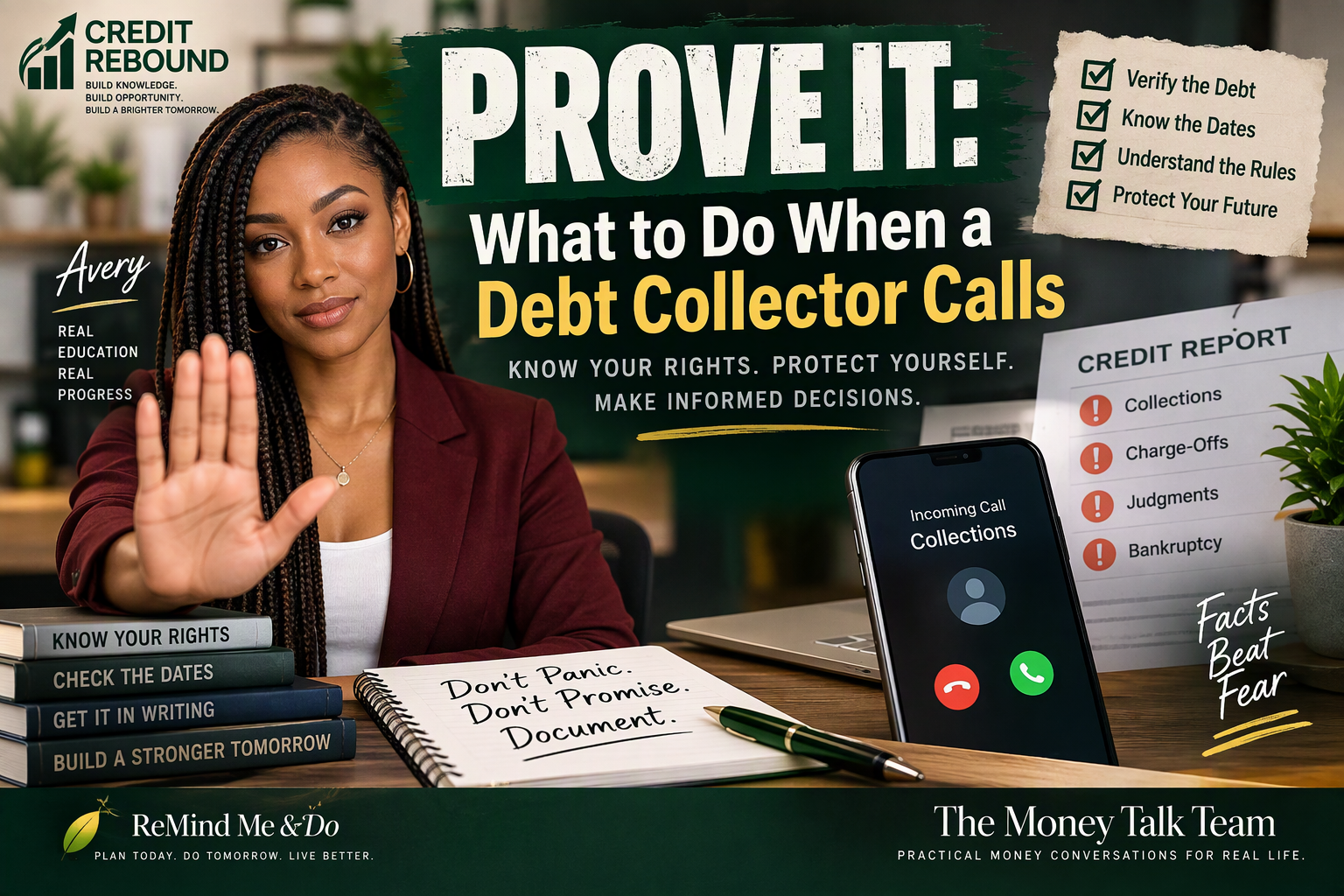
A debt-collection call can catch you completely off guard.
Maybe you recognize the creditor but haven't heard anything about the account for years. Maybe the name of the collection company is completely unfamiliar. Maybe an old account suddenly appears on a credit report with a newer-looking date.
The natural reaction may be:
“I need to take care of this immediately.”
Credit Rebound wants you to slow that moment down.
Before deciding whether to pay, dispute, negotiate, or take another action, understand who is contacting you, what debt is being claimed, what dates matter, and what rights may apply.
Our rule for today is simple:
Don't Panic. Don't Promise. Document.
That doesn't mean legitimate debts should simply be ignored. The Consumer Financial Protection Bureau advises consumers to use contact from a collector as an opportunity to learn more about the debt and determine whether the collector is legitimate and whether the debt belongs to them.
Step 1: Who Is Calling?
Start by identifying the collector and the debt being claimed.
Don't provide sensitive financial information simply because someone calls and says money is owed. The CFPB recommends confirming that the collector and debt are legitimate first.
You want to understand:
- Who is collecting?
- Who is the creditor?
- What account is involved?
- How much is being claimed?
- Do you recognize the debt?
- Is the amount correct?
- Is this an account you already paid?
- Is this an old debt you haven't heard about for years?
The objective isn't to win an argument during the telephone call.
The objective is to understand what you're dealing with.
Step 2: Ask for the Information Behind the Debt
Federal debt-collection rules generally require a debt collector to provide certain validation information during the initial communication or within five days of that initial communication.
The CFPB explains that the validation notice generally contains information including:
- The debt collector's information
- The creditor's name
- An account number, if applicable
- An itemization of the amount claimed
- The current amount of the debt
- Information about disputing the debt
- The end date of the applicable 30-day dispute period
This is an important Credit Rebound principle:
A collection call is not the same thing as proof that every detail being presented is correct.
Get the information. Review it. Compare it with your own records.
Step 3: Find the Original Creditor
An unfamiliar collection-company name doesn't necessarily mean the underlying debt is unfamiliar.
Collection accounts may involve a creditor different from the company currently trying to collect.
During the applicable 30-day period, consumers can request the name and address of the original creditor if that original creditor differs from the current creditor.
That gives us another Credit Rebound question:
“Who did this debt originally belong to?”
Don't stop your investigation at the collection company's name.
Step 4: The Seven-Year Rule Isn't Based on Whoever Owns the Debt Today
This is one of the biggest areas of confusion.
Most negative credit information generally may be reported for seven years, although some categories have different rules and exceptions.
For charge-offs and collection accounts subject to the applicable FCRA provisions, FTC guidance explains that the reporting period is connected to the commencement of the delinquency that immediately preceded the collection or charge-off, with the seven-year period beginning 180 days after that delinquency began.
What does that mean?
Imagine an account becomes delinquent and is never brought current again.
Later:
The original creditor charges it off.
Then:
Collector A receives or buys the account.
Later:
Collector B receives or buys the account.
A later collection company doesn't get to create an entirely new credit-reporting period merely because it obtained the account later.
The FTC specifically concluded that the sale or transfer of a charged-off account does not change the allowable reporting period for that charge-off.
That's why dates matter.
A newer date associated with a collection company should not automatically be interpreted as the beginning of a brand-new seven-year reporting period.
Step 5: Understand the Two Clocks
This deserves special attention because two completely different timing questions can surround an old debt.
Clock #1: The Credit-Reporting Clock
This concerns how long negative information can generally be included on a consumer's credit report.
The CFPB says most negative information generally may be reported for seven years.
Clock #2: The Statute-of-Limitations Clock
This concerns the time available for a lawsuit over a debt.
This is not the same clock.
FTC consumer guidance explains that statutes of limitations can depend on state law and the type of debt. It also warns that, in some states, making a payment or acknowledging a debt in writing can restart the limitations period.
That's why Credit Rebound should never teach:
“It's been seven years, so nobody can sue you.”
That mixes two separate legal concepts.
When an old debt may involve legal consequences, obtaining individualized legal advice can be appropriate before taking an action that could affect someone's rights.
Step 6: What About Simply Talking to the Collector?
Don't confuse answering a telephone call with the different actions that may have legal consequences.
The federal consumer guidance we've reviewed specifically warns about circumstances such as making a payment or, in some states, acknowledging a debt in writing when dealing with a statute-of-limitations issue.
That gives Credit Rebound another rule:
Understand the debt before making promises or payments on an old account.
Ask questions. Gather information. Document what happened. Then make an informed decision.
Step 7: The 30-Day Period Matters
A validation notice generally identifies the end of a 30-day period for disputing the debt.
If a consumer sends a qualifying written dispute within the applicable period, CFPB guidance says the collector must pause collection of the disputed debt until the collector sends verification responding to the dispute.
That's an important protection.
But notice what we didn't say:
“The collector has 30 days to prove the debt.”
The 30 days discussed here concern an important period for the consumer to exercise certain dispute rights.
We don't want Credit Rebound readers walking away believing that every collector automatically loses the debt if no verification arrives within 30 days.
Step 8: Put Important Requests in Writing
For purposes of these federal dispute and original-creditor provisions, CFPB regulations recognize written requests made through methods including mail, certain electronic communication channels accepted by the collector, the consumer-response form, or delivery in person or by courier.
Why does written communication matter?
Because memories fade.
Telephone conversations can be misunderstood.
A written record gives you something concrete to preserve.
Build a Credit Rebound Collection File
For every collection account, create a record containing:
Collection company: Original creditor: Account/reference number: Amount claimed: Date first contacted: Validation notice received: Date written dispute/request sent: Method used: Proof of delivery: Response received: Notes:
The CFPB recommends preserving letters, documents, and communications and writing down dates and times of conversations along with notes about what was discussed.
Step 9: Build a Paper Trail You Can Actually Follow
This is where an old-fashioned documentation habit still teaches us something useful.
Years ago, some people created an additional dated record by mailing themselves an identical copy of important correspondence and leaving the postmarked envelope sealed.
The thinking was simple:
Create the record today instead of trying to reconstruct it years later.
But Credit Rebound does not recommend treating an unopened self-addressed envelope as guaranteed legal proof of what was inside or assuming a court must accept it.
Evidence may need to be authenticated, and admissibility is governed by applicable rules of evidence. Federal Rule of Evidence 901, for example, generally requires sufficient evidence to support a finding that an item is what its proponent claims it is.
Instead, our modern Credit Rebound documentation system should be stronger.
Keep an exact copy of what you send.
If you send a letter, preserve the exact letter.
If you include supporting documents, preserve copies of those documents too.
If a payment accompanies correspondence, keep the appropriate payment records.
Use a trackable mailing method when appropriate.
USPS says Certified Mail provides the sender with a mailing receipt as confirmation that an item was sent.
USPS also states that a properly postmarked Certified Mail receipt can serve as legal proof of mailing.
Consider Return Receipt when proof of delivery matters.
USPS says Return Receipt provides the sender with proof of delivery and can include the delivery date and time, the signature of the recipient or authorized agent, and information about the delivery address when applicable.
Keep everything together.
Your Credit Rebound file might contain:
- Exact copy of the letter sent
- Copies of supporting documents
- Certified Mail receipt
- USPS tracking information
- Return Receipt or electronic delivery confirmation
- Relevant payment records
- Collector's response
- Notes from telephone conversations
- Dates and times of communications
If you provide supporting documents concerning a payment, CFPB guidance recommends sending copies and retaining your originals.
Credit Rebound Recordkeeping Rule
If it's important enough to send, it's important enough to document.
The goal isn't to create a clever courtroom trick.
The goal is to create a clear, organized record of what happened, what you sent, when you sent it, where you sent it, and what happened afterward.
Step 10: What If the Collector Doesn't Respond?
Here's where misinformation can become dangerous.
You may hear:
“If they don't prove it within 30 days, the debt disappears.”
That is not the lesson Credit Rebound will teach.
For a timely written dispute that triggers the applicable federal protection, CFPB guidance says collection activity must stop until the collector sends verification responding to the dispute.
That does not automatically mean the underlying debt has been erased or forgiven.
There is a major difference between:
The collector must stop covered collection activity until responding with verification
and
The debt no longer exists.
Don't confuse the two.
Step 11: What If Collection Continues Anyway?
This is why your documentation matters.
Your letters, mailing receipts, delivery confirmations, notices, responses, and telephone notes can create a timeline of what happened.
If you believe a debt collector is violating your rights, the CFPB says consumers can submit a complaint to the CFPB and can also contact their state attorney general. The CFPB also identifies consulting a lawyer who specializes in debt-collection matters as an option when an issue cannot be resolved.
And if someone actually receives a lawsuit, don't treat it like another collection letter.
FTC guidance tells consumers not to ignore lawsuits over old debts.
Step 12: Old Doesn't Automatically Mean Gone
An old debt creates several separate questions:
- Is the debt mine?
- Is the amount accurate?
- Who owns it now?
- Who was the original creditor?
- When did the delinquency begin?
- Is the account being reported accurately?
- Is the information still within the applicable credit-reporting period?
- What statute of limitations applies?
Those questions do not necessarily have the same answer.
That's exactly why Credit Rebound says:
PROVE IT.
Not because we're trying to avoid legitimate obligations.
Because informed financial decisions begin with accurate information.
The Credit Rebound PROVE IT Method
When a collector contacts you, remember:
P — Pause
Don't let pressure make the decision.
R — Recognize
Identify the collector, creditor, amount, and account.
O — Obtain Information
Get the validation information and investigate anything unfamiliar.
V — Verify
Compare what you're being told with your records and credit reports.
E — Establish the Dates
Find the dates that actually matter.
I — Investigate Before Acting
Especially when dealing with old debt.
T — Track Everything
Letters. Calls. Dates. Mailing receipts. Delivery confirmations. Responses.
PROVE IT isn't about refusing responsibility.
It's about replacing fear and confusion with information.
Today's Credit Rebound Action
Don't wait for the next unexpected collection call.
Create a folder today called:
Credit Rebound — Collections & Disputes
If something arrives, preserve it.
If someone calls, document it.
If you send something, keep an exact copy.
If something appears on a credit report that you don't recognize, don't immediately assume either that it's legitimate or that it's fraudulent.
Investigate first.
Coming Next: Get Your Credit Reports
Now that we understand why dates and account history matter, our next Credit Rebound lesson will show you where to obtain your credit reports and what you're actually getting.
Then we'll do something even more important:
How to Read Your Credit Report
We'll create a fictional Credit Rebound sample credit report and walk through it piece by piece.
We'll examine:
- Accounts
- Balances
- Payment history
- Late payments
- Collections
- Charge-offs
- Inquiries
- Important dates
- Public-record information when applicable
- Other information people commonly encounter
Because before you can build a Credit Rebound plan, you need to understand what the report is actually telling you.
Sources & Further Reading
- Consumer Financial Protection Bureau | “What information does a debt collector have to give me about a debt they’re trying to collect from me?”
- Consumer Financial Protection Bureau | “What can I do if a debt collector contacts me about a debt I already paid or don't think I owe?”
- Consumer Financial Protection Bureau | “What should I do when a debt collector contacts me?”
- Consumer Financial Protection Bureau | “Can a debt collector still collect a debt after I've disputed it?”
- Consumer Financial Protection Bureau | Regulation F § 1006.38, “Disputes and requests for original-creditor information.”
- Consumer Financial Protection Bureau | “How long does information stay on my credit report?”
- Federal Trade Commission | Advisory Opinion to Amason, addressing charge-off reporting periods and subsequent events.
- Federal Trade Commission | Advisory Opinion to Johnson, addressing commencement of delinquency.
- Federal Trade Commission | Consumer guidance concerning old debts and statutes of limitations.
- United States Postal Service | Certified Mail and Return Receipt guidance.
Educational Disclaimer
Credit Rebound, The Money Talk Team, and ReMind Me & Do provide general financial education and informational content only.
This article is not individualized financial, legal, tax, debt-settlement, debt-management, or credit-repair advice.
Debt-collection rights, statutes of limitations, legal procedures, evidentiary requirements, and other rules can vary depending on the type of debt, individual circumstances, applicable federal law, and state law.
Nothing in Credit Rebound guarantees removal of accurate information from a credit report, cancellation of a debt, improvement in a credit score, approval for credit, or any particular financial outcome.
If you're dealing with an old debt, lawsuit, judgment, bankruptcy, disputed ownership of a debt, or another matter with legal consequences, consider consulting a qualified attorney or other appropriate professional about your individual circumstances.
Credit Rebound
Build knowledge. Build opportunity. Build a brighter tomorrow.
Don't panic. Don't promise. Document. Then make an informed decision.
Watch Today’s Money Talk
Tomorrow on Money Talk
Get Your Credit Reports Then: How to Read Your Credit Report — a fictional Credit Rebound sample credit report, walked through piece by piece.
Please like, follow and subscribe so we can continue bringing you valuable, fact-based financial education.
The Money Talk Daily provides general financial education and news. It is not individualized financial, investment, tax or legal advice.