Money Talk Team
The Holiday Spending Squeeze: Thanksgiving, Black Friday, Cyber Monday... and the Bills That Still Come Due
Thanksgiving, Black Friday and Cyber Monday can create several days of intense spending pressure, but December bills don't disappear because something is on sale. The Money Talk Team looks at holiday shopping, consumer credit, the markets and a practical approach to protecting essential obligations while still leaving room to enjoy the season.
By Money Talk Team | Avery Brooks & Matt Bennett
November 26, 2026 at 2:54 AM
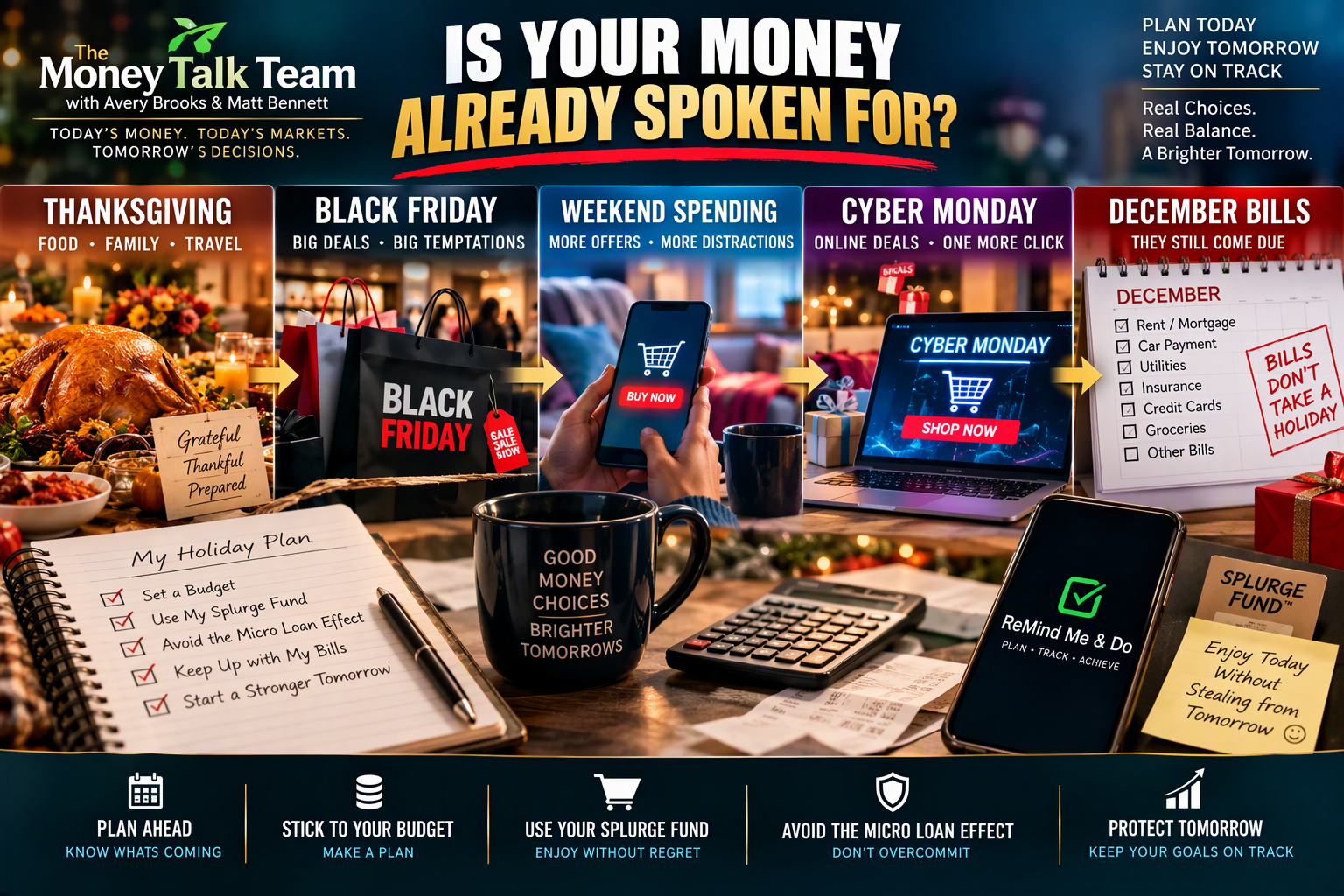
The Holiday Shopping Season Is Here
Thanksgiving week brings family, food, travel, celebrations and some of the biggest shopping promotions of the year.
First comes Thanksgiving.
Then Black Friday.
Then a weekend filled with sales and promotions.
Then Cyber Monday.
And after all of it?
December still arrives.
So does rent. The mortgage. The car payment. Insurance. Utilities. Credit cards. Groceries. Fuel.
And everything else that existed before the first Black Friday advertisement arrived.
That's why today's Money Talk isn't about telling you not to shop.
It's about making sure the holiday shopping season doesn't make financial decisions for you.
MATT | LOOK AT THE BIGGER FINANCIAL PICTURE
Before we get to Avery's spending plan, let's look at what's happening around consumers.
The latest published Federal Reserve consumer-credit data show that consumer credit increased at a seasonally adjusted annual rate of 4.2% during the third quarter of 2026. Revolving credit increased at a 4.1% annual rate during the quarter.
The Federal Reserve's published commercial-bank data also showed an average rate of 21.19% on credit-card plans across all accounts and 22.36% on accounts assessed interest for the third quarter.
That's important context when we're talking about holiday spending.
A purchase doesn't necessarily end when you leave the store.
If the purchase becomes revolving credit-card debt, the cost can continue beyond the holiday.
And the economy is giving consumers mixed signals.
The latest available Bureau of Economic Analysis data show that consumer spending increased 0.5% in September, while the personal saving rate was 3.8%.
The latest PCE price-index reading available before Thanksgiving showed prices 3.6% higher in September 2026 than a year earlier. The next Personal Income and Outlays release is scheduled for November 25.
Meanwhile, the November Consumer Confidence Index rose to 103.3 from 91.9 in October, according to The Conference Board. The organization also reported that consumers planned slightly higher spending on goods and vacations, even while write-in responses continued to express frustration about high prices and rising costs.
So there is spending enthusiasm.
But there is also financial pressure.
That combination is exactly why planning matters.
AVERY | A SALE DOESN'T CANCEL YOUR BILLS
Now let's bring this back home.
Imagine you get paid.
Your account balance looks good.
Thanksgiving arrives.
You buy groceries.
Maybe you're cooking for family.
Maybe you're traveling.
Maybe you're bringing something to somebody else's home.
That's money.
Then Friday arrives.
Black Friday.
A television is on sale.
A laptop is discounted.
Shoes are 40% off.
Christmas gifts are everywhere.
Saturday comes and the promotions continue.
Sunday arrives and your inbox is still full of offers.
Then Monday comes.
Cyber Monday.
Another round of countdown clocks.
Another round of “Today Only.”
Another round of:
Don't miss this deal.
But here's the question I want you to ask before you click BUY:
What money in my account already belongs to something else?
A $200 Deal Can Still Cost You $200
Suppose something normally costs $300.
Black Friday price:
$200
The advertisement tells you:
YOU SAVED $100.
Maybe you did get a lower purchase price.
But let's look at your budget.
If that $200 was already needed for rent, the car payment, insurance, electricity or another obligation, then the sale didn't make the obligation disappear.
You still spent $200.
That's why Money Talk is going to keep repeating this:
A discount can lower the price of something you planned to buy. It doesn't automatically make an unplanned purchase affordable.
There is a difference between:
getting a good price
and
making a good financial decision.
Sometimes they're the same.
Sometimes they aren't.
BLACK FRIDAY DOESN'T END THE PRESSURE
Here's another reason we're expanding this conversation beyond Black Friday.
Holiday promotions aren't confined to Friday.
Current industry research describes the Thanksgiving-to-Cyber-Monday period as an important shopping window, with Cyber Monday remaining particularly important for online shopping.
That changes the budgeting problem.
You don't only have to survive one shopping day.
You can encounter:
Thanksgiving promotions
Then:
Black Friday
Then:
Saturday and Sunday weekend offers
Then:
Cyber Monday
And promotions can continue throughout December.
That's why our financial plan needs to cover the entire spending period, not simply Friday morning.
THE MONEY TALK HOLIDAY RULE
Before Thanksgiving spending starts, we want you to identify four things.
1. Protect your obligations
First identify every major obligation due before your next two paychecks.
That may include:
- Rent or mortgage
- Car payment
- Insurance
- Electricity
- Water
- Phone
- Internet
- Credit-card payments
- Loan payments
- Childcare
- Other required expenses
Don't wait for the due date to remember the bill exists.
The money may need to be protected before the bill arrives.
2. Budget for the holiday itself
Thanksgiving costs money.
Don't make the mistake of budgeting for holiday gifts while forgetting holiday living.
Think about:
- Groceries
- Travel
- Fuel
- Hosting
- Eating out
- Family activities
- Gifts
- Decorations
- Unexpected purchases
The CFPB's budgeting resources encourage consumers to track income, bills and spending, including everyday categories such as groceries, eating out and entertainment.
That's exactly the mindset we want.
Budget real life, not imaginary life.
3. Know your Splurge Fund™
Now here's one of our Credit Rebound practices.
Splurge Fund™
People are going to enjoy the holidays.
That's not the problem.
The problem comes when enjoyment has no boundary.
For Credit Rebound, we're using approximately 3%–4% of actual take-home income as a starting Splurge Fund guideline, provided essential obligations can first be covered.
That is our educational guideline, not a universal financial rule.
What matters is the practice:
Give the splurge a number before the splurge begins.
Maybe you see something you didn't plan to buy.
Fine.
Check the Splurge Fund.
There's money available?
You decide whether the purchase is worth it.
The Splurge Fund is empty?
The splurge stops.
Not because you're being punished.
Because the money waiting for rent isn't actually available spending money.
4. Don't Forget Emergency Cash
The holidays don't protect you from emergencies.
Cars still break.
Appliances still fail.
People still get sick.
Unexpected expenses still happen.
So we're not going to celebrate finding a Black Friday discount if getting that discount required completely emptying the money protecting us from the next emergency.
The CFPB's financial-education toolkit includes savings, bill tracking, cash-flow budgeting and debt management as interconnected parts of money management.
That connection is fundamental to Money Talk.
THE CYBER MONDAY TEST
Cyber Monday creates a special problem.
You don't even have to leave your home.
You're sitting on the couch.
The phone is right there.
Your card information may already be saved.
The advertisement follows you.
The email says:
FINAL HOURS.
That's when we want you to take the:
CYBER MONDAY TEST
Before checkout, ask:
- Was this on my list before I saw the sale?
- Is the money actually available after protecting my obligations?
- Am I buying the product, or am I reacting to the countdown clock?
- Would I still want it if I had to pay the entire cost today?
- Am I about to create another future payment?
Those five questions can slow down a purchase long enough for you to make the decision instead of the advertisement making it for you.
THE MICRO LOAN EFFECT™ DURING THE HOLIDAYS
Here comes another Credit Rebound lesson.
A $25 payment looks small.
Four payments of $25 can make a $100 purchase feel like a $25 purchase.
But the product didn't cost $25.
It cost $100.
You simply moved part of the payment into the future.
Then imagine doing that again.
And again.
And again.
That's what Credit Rebound calls:
The Micro Loan Effect™
Our educational term describes the pressure that can develop when several individually small borrowing or installment obligations begin consuming future income.
This is particularly important during a promotional period when you may encounter multiple Buy Now, Pay Later offers.
CFPB says many BNPL products don't charge interest, but most charge late fees if payments aren't made on time. Policies vary by provider, and consumers should review the specific terms and conditions.
So the question isn't simply:
“Can I afford $25 today?”
Ask:
“How many $25 payments are already waiting for my next paycheck?”
That's the number we need to see.
MONEY FLEX | THE MONEY MAY ALREADY HAVE A JOB
This is where Money Flex inside ReMind Me & Do connects to holiday planning.
Money Flex is built around the idea that the amount sitting in your account isn't necessarily the amount truly available to spend.
Part of that money may already belong to:
Rent. The car. Insurance. Utilities. Debt. Groceries. Savings. Other obligations.
Our mindset is:
Don't wait for the bill. Prepare for the bill.
During Black Friday and Cyber Monday, that's especially important.
Before you look at a sale, look at what the money needs to do after the sale ends.
MATT | DON'T LET MARKET HEADLINES CONTROL YOUR HOUSEHOLD
There's another kind of pressure people experience during volatile financial periods.
Market headlines.
One day stocks are falling.
The next day they may rebound.
Commentators start talking about buying opportunities.
Other commentators predict more declines.
Money Talk wants to make an important distinction:
Your household financial plan and today's stock-market movement are not the same thing.
If you're struggling to cover December obligations, draining essential cash to chase a market move may create a completely different financial problem.
Matt's job here isn't to tell you what investment to buy.
It's to help you understand what is happening.
Then you make decisions based on:
Your goals. Your risk tolerance. Your time horizon. And your actual financial circumstances.
Education first.
Action second.
BEFORE YOU OPEN ANOTHER STORE CARD
Holiday checkout counters often present another temptation:
“Open an account and receive a discount today.”
Stop.
Read.
Think.
Then decide.
A discount doesn't automatically make another credit account appropriate for your situation.
The CFPB's credit-card rules require card issuers to consider a consumer's ability to make required minimum periodic payments when opening certain credit-card accounts or increasing applicable credit limits.
But you're responsible for a different question:
Do I actually need another account?
Don't let a discount make that decision for you.
WHAT HAPPENS AFTER THE HOLIDAYS?
This is where people can lose perspective.
Holiday advertisements focus on:
TODAY.
Money Talk wants you thinking about:
JANUARY.
What happens when the holiday is over?
The gifts have been opened.
The food is gone.
The decorations start coming down.
But the credit-card balance remains.
The installment payment remains.
The BNPL payment remains.
The loan remains.
January-you has to deal with whatever November-you and December-you agreed to.
That's why today's enjoyment has to remain connected to tomorrow's obligations.
OUR BLACK FRIDAY/CYBER MONDAY RULE
Before buying something that wasn't planned, pause and ask:
1. NEED
Do I actually need it?
2. PLAN
Was it already in my holiday budget?
3. CASH FLOW
What obligations are coming before my next two paychecks?
4. SPLURGE
Is there enough in my Splurge Fund™?
5. FUTURE PAYMENT
Am I creating another Micro Loan Effect™ obligation?
6. EMERGENCY
Am I touching money protecting me from an emergency?
7. TOMORROW
Will I still feel comfortable with this purchase when the sale is over?
If the answers work?
Make your informed decision.
If they don't?
There will be another sale.
Protecting your financial stability matters more than winning a countdown clock.
TODAY'S MONEY MOVE
Before Thanksgiving shopping begins, make one list.
At the top write:
MONEY ALREADY SPOKEN FOR
Underneath, list every required obligation that needs funding before your next two paychecks.
Then create separate amounts for:
- Holiday Spending
- Splurge Fund™
- Emergency / Future
Whatever remains after protecting those categories is much closer to your true flexibility than your current checking-account balance.
THE BOTTOM LINE
The holiday season should be enjoyed.
Credit Rebound and Money Talk are not about eliminating Thanksgiving dinner.
We're not eliminating gifts.
We're not eliminating Black Friday.
And we're certainly not pretending Cyber Monday won't tempt us.
We're doing something different.
We're preparing.
Because:
The sale may end Monday, but your bills don't.
And:
A good deal shouldn't create a bad January.
Think before you click.
Know what the money already needs to do.
Give the splurge a number.
Protect tomorrow while you enjoy today.
That's smarter money.
Key takeaways
- 01Thanksgiving, Black Friday, weekend promotions and Cyber Monday can create several consecutive days of spending pressure.
- 02A lower price does not automatically mean a purchase fits your budget.
- 03Identify obligations due before your next two paychecks before determining available holiday spending.
- 04Holiday budgeting should include groceries, travel, gifts, entertainment and other real-life expenses.
- 05Splurge Fund™ creates an intentional boundary for discretionary spending.
- 06Don't sacrifice emergency reserves for an unplanned sale purchase.
- 07Several small BNPL/installment payments can collectively create the Micro Loan Effect™.
- 08Another store-card discount isn't automatically a reason to open another credit account.
- 09Money Flex encourages people to recognize when money currently in their account already belongs to a future obligation.
- 10Black Friday and Cyber Monday decisions should consider what happens when January arrives.
Today’s Money Move
Create your “Money Already Spoken For” list before the holiday shopping begins. Protect bills first. Include real living expenses. Set the Splurge Fund™. Preserve emergency money. Then determine what's genuinely available for holiday shopping.
Sources & Further Reading
- Consumer Financial Protection Bureau | Your Money, Your Goals Toolkit
- Consumer Financial Protection Bureau | Spending Tracker
- Consumer Financial Protection Bureau | Buy Now, Pay Later Fees
- Consumer Financial Protection Bureau | Holiday Spending Plan (Archived CFPB educational material)
- Federal Reserve Board | Consumer Credit, G.19, November 6, 2026
- U.S. Bureau of Economic Analysis | Consumer Spending
- U.S. Bureau of Economic Analysis | Personal Saving Rate
- U.S. Bureau of Economic Analysis | PCE Price Index
- The Conference Board | U.S. Consumer Confidence, November 2026
Watch Today’s Money Talk
Today’s video will be linked here.
Tomorrow on Money Talk
Road to 750: Know Your Starting Point Before changing anything, we're going to begin where real credit education should begin: Understanding what's actually on the credit reports, identifying legitimate inaccuracies, and separating information that may need to be disputed from accurate information that may require time, consistency and better financial habits. No quick fixes. Facts first.
Please like, follow and subscribe so we can continue bringing you valuable, fact-based financial education.
The Money Talk Daily provides general financial education and news. It is not individualized financial, investment, tax or legal advice.